
Key takeaways
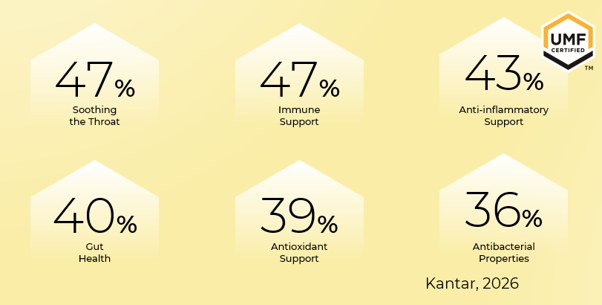
- Consumers expect throat soothing and immune support from mānuka honey: According to new Kantar research, top benefits consumers expect from mānuka honey include soothing the throat (47%), immune support (47%), anti-inflammatory support (43%), and gut health (40%).
- Honey is a well-established throat soother. Honey’s thick texture coats irritated tissue and acts as a demulcent for cough and sore throat, and the complexity and bioactives in mānuka honey add additional benefits.
- New lab research from Aston University found that mānuka honey’s antimicrobial activity rises with UMF grade and can’t be replicated by sugar and methylglyoxal (MGO) alone, pointing to a synergy of compounds in mānuka honey that provide antimicrobial power.
- Early immune research is promising but preclinical. A 2022 study in Frontiers in Immunology found immunomodulatory properties from mānuka honey in cell and animal models.
- Look for the UMF quality mark to confirm authentic, independently verified New Zealand mānuka honey.
What do consumers want from mānuka honey?
As cold and flu season begins, more U.S. consumers are reaching for mānuka honey, and they have clear expectations. New Kantar research asked consumers which benefits they most associate with mānuka honey. Soothing the throat and immunity tied for the top spot at 47% each, followed by anti-inflammatory support (43%) and gut health (40%).
These expectations shape the questions dietitians, health professionals and shoppers bring to the conversation, which makes it important to understand what the science does and doesn’t support.
Does mānuka honey soothe a sore throat?
Honey has a long track record here, where its viscous texture coats irritated tissue and acts as a demulcent, easing the scratchy feeling of a sore throat and cough. Most of that clinical research is on honey in general rather than mānuka specifically. What sets mānuka apart is its distinctive and complex chemistry, which is where the newest research comes in.
Does mānuka honey have antimicrobial activity against respiratory bacteria?
In laboratory testing, yes, and the picture is more complex than once thought. A new study from Aston University, led by Dr. Jonathan Cox in partnership with Comvita and published in Microbiology, tested mānuka honeys of different UMF grades against bacteria that cause respiratory infections. Antimicrobial activity increased as UMF rating increased.
The surprising finding: artificial mixtures of sugar and MGO couldn’t reproduce the effect. That suggests other bioactive compounds, or interactions between them, contribute to mānuka honey’s antimicrobial activity. In other words, it isn’t just about one compound (MGO), but likely the synergy between MGO and the many other compounds in this complex honey.
Read the Aston University research
Can mānuka honey support the immune system?
Early research suggests it may interact with immune pathways. A 2022 study in Frontiers in Immunology by Masad et al. found that mānuka honey (UMF 20+) triggered immune signaling, including increased TNF-α, in cell and animal models, and exhibited immunomodulatory properties. This points to a plausible way mānuka honey could influence immune function.
As with the Aston research, this is preclinical work. It offers a strong reason for further human studies, and it isn’t proof of a specific health outcome.
Read the immune-modulating study
What is UMF, and why does it matter?
UMF stands for Unique Mānuka Factor. The UMF trademark verifies that a honey is authentic New Zealand mānuka honey and meets quality standards, with grades ranging from UMF 5+ to 20+. In the Aston study, higher UMF grades showed stronger antimicrobial activity in the lab. When shopping, look for the UMF quality mark and rating on the label.
In the news
Lisa Maxbauer recently wrote about this topic for Woman’s World, now featured on Yahoo Health: “Manuka Honey May Help You Avoid Respiratory Viruses This Cold and Flu Season.” It’s a helpful look at how mānuka honey is reaching consumers who want to stay healthy this season, including practical serving ideas and a reminder to look for a UMF rating on the label.
Frequently asked questions
What do consumers most associate with mānuka honey? According to Kantar research, soothing the throat and immunity (47% each), followed by anti-inflammatory support (43%) and gut health (40%).
Is mānuka honey good for a sore throat? Honey in general is a well-supported demulcent for sore throat and cough. Mānuka honey shares those properties and adds more bioactives and potential health benefits, though most clinical cough research has been done on honey broadly.
Does mānuka honey boost immunity? Early cell and animal research shows immunomodulatory properties. Human studies are still needed, so it’s best described as promising rather than proven.
Coming soon: a new course on mānuka honey science
We’re excited to share that a new course on the science behind mānuka honey and maintaining health is coming soon, in partnership with Today’s Dietitian. Sign up here to be the first to know when it’s available.


