Not all mānuka honey is created equal, and science now proves it. With U.S. mānuka honey sales up 52% last year, the market has grown faster than consumer understanding of what makes a product genuinely bioactive. New research confirms that authentic mānuka honey is defined by plant genetics, geographic origin, and multi-marker certification. None of these factors can be replicated by products from outside New Zealand, regardless of how they are labeled.
Is All Mānuka Honey the Same?
No. Despite sharing a name, mānuka honeys vary significantly in their molecular composition, bioactivity, and origin, and those differences have real consequences for the health properties consumers seek.
Authentic UMF™ mānuka honey comes exclusively from the nectar of New Zealand’s native Leptospermum scoparium, the mānuka tree. Two recent peer-reviewed studies confirm that New Zealand L. scoparium is genetically distinct from Australian Leptospermum species, despite sharing a genus name. The two plant lineages have been diverging for between 9 and 20 million years, meaning the mānuka tree, as a species, is unique to New Zealand alone.
Research shows the consequences of that distinction are measurable in the honey itself:
- New Zealand mānuka honey and Australian Leptospermum honeys have markedly different molecular compositions, with over 50% of detected features differing between the two, regardless of their methylglyoxal (MGO) content.
- The chemical markers used to authenticate mānuka honey are either absent or present at significantly different levels in Australian Leptospermum honeys.
- None of the Australian samples in recent testing met New Zealand’s Ministry for Primary Industries definition of mānuka honey, or the criteria required to pass the UMF™ quality test.
What Is UMF™ Mānuka Honey?
UMF™ stands for Unique Mānuka Factor, a globally recognized quality certification for authentic New Zealand mānuka honey. The UMF™ grading system independently verifies a honey’s purity, potency, and origin through multi-marker testing, ensuring consumers receive genuine mānuka honey with the bioactive compounds responsible for its documented health properties.
UMF™ grades range from UMF™ 5+ to UMF™ 25+, with higher grades indicating greater concentration of key bioactive markers. Every UMF™ certified product is traceable to a licensed New Zealand producer and has passed independent laboratory testing (not self-reported claims).
What Does UMF™ Certification Actually Test?
This is where UMF™ certification differs fundamentally from other labeling on the market. Rather than measuring a single compound, the UMF™ four-factor quality test evaluates:
- Leptosperin — a chemical marker unique to L. scoparium nectar, confirming floral origin
- DHA (dihydroxyacetone) — a precursor to MGO, confirming freshness and authentic nectar conversion
- MGO (methylglyoxal) — the primary antibacterial compound
- HMF (hydroxymethylfurfural) — an indicator of honey freshness and correct storage
Together, these markers create a molecular fingerprint that can only come from genuine New Zealand mānuka honey. This is why authentic mānuka honey cannot be defined by any single compound — it is the product of a specific interplay between plant genetics, nectar chemistry, environment, and geography that gives it elevated levels of phenolic compounds, enzymes, organic acids, and more than 2,000 bioactive compounds in total.
UMF™ vs. MGO: Why One Number Isn’t Enough
MGO – methylglyoxal – is mānuka honey’s best-known antibacterial compound, and MGO rating is widely used as a standalone marketing claim by many products on the market. But new research makes clear that MGO alone is not a sufficient measure of authenticity or bioactivity.
The molecular profiles of New Zealand mānuka honey and Australian Leptospermum honeys differ significantly regardless of their MGO content. A honey can contain comparable MGO levels and still lack the full complement of bioactive compounds, chemical markers, and traceable geographic origin that define genuine mānuka honey.
UMF™ certification measures MGO as one of four factors, not the only one. That distinction matters for consumers who want confidence that what they’re buying delivers the full bioactive profile the research supports, not just one isolated compound.
Why Authenticity Is the Most Important Factor When Buying Mānuka Honey
Consumer awareness of this issue is growing. 89% of consumers say that aside from price, authenticity is the most important factor when choosing a mānuka honey brand – a figure that reflects how much trust and purchasing confidence depend on verifiable quality assurance.
When someone asks whether their mānuka honey is “the real deal,” UMF™ is currently the only certification that can answer with confidence: tested, traceable, and verified to originate exclusively from New Zealand.
For anyone navigating the mānuka honey market, look for:
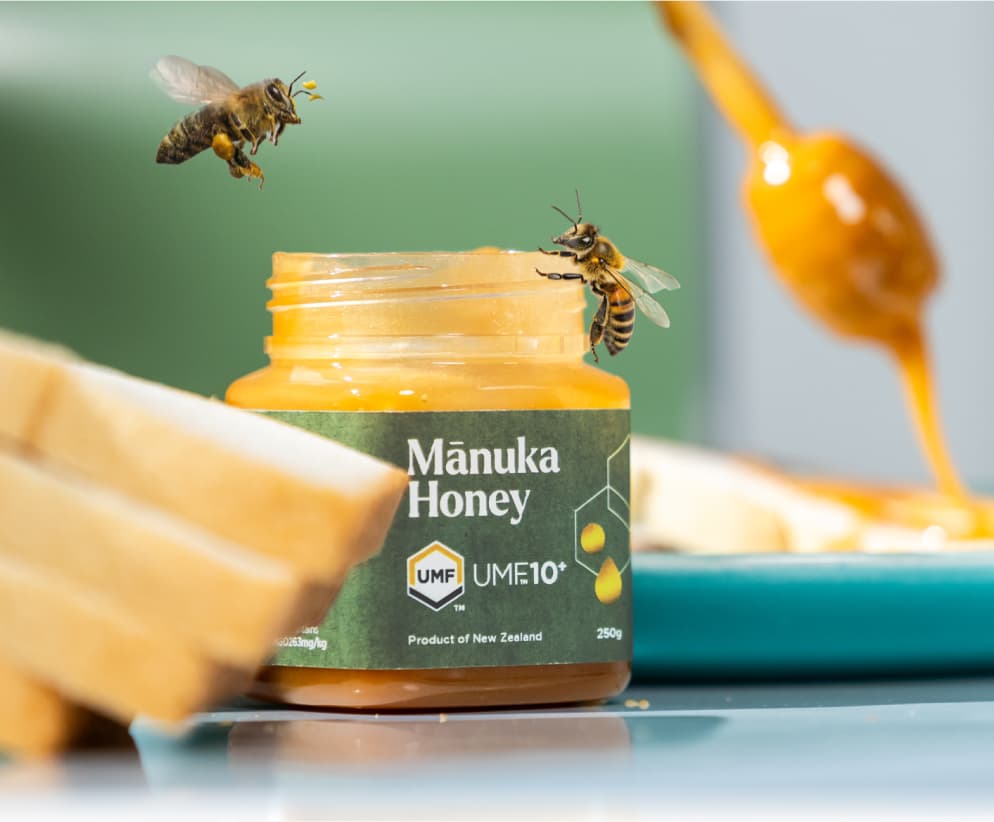
- The UMF™ logo on the front of the jar, along with a UMF™ grade (UMF™ 5+ through UMF™ 25+)
- A license number confirming the producer is an authorized UMFHA member
- Country of origin: New Zealand, the only place authentic mānuka honey can come from
The Science-Backed Case for Authentic Mānuka Honey
The research is clear: geographic origin, plant genetics, and multi-marker certification are not optional details in mānuka honey — they are the foundation of its bioactivity. Products that rely on MGO alone, or that source honey from outside New Zealand, are not equivalent, regardless of how they are labeled.
UMF™ certification exists to make that distinction simple, consistent, and verifiable for everyone.
To explore the full body of research behind mānuka honey authentication, visit the UMF™ Mānuka Honey Health Research Database. To learn more about how UMF™ certification works, visit the UMF™ Quality Assurance System and Four-Factor Quality Testing pages.
References
- Ross & Braggins, Food Chemistry Advances, 2023
- Chagné et al., Tree Genetics & Genomes, 2023
- 2026 Consumer Research, Kantar


